PROPAGANDA BY THE DEED OF REMEMBERANCE · AGE OF REASON
Maquinaciones MNCARS, Madrid 2023
PROPAGANDA POR EL ACTO DE RECORDAR · EDAD DE LA RAZÓN
Maquinaciones MNCARS, Madrid 2023
(<atras-back)

Maquinaciones: 21 Jun 2023 – 28 Aug 2023 · MNCARS
Curated by
Pablo Allepuz, Manuel Borja-Villel, iLiana Fokianaki, Rafael García and Teresa Velázquez
Artists
Georges Adéagbo, Efrén Álvarez, Ismaïl Bahri, Sammy Baloji, Jean-Pierre Bekolo, Ahmed Bouanani, Touda Bouanani, Paula Guerrero and Esperanza Collado, Rojava Film Commune, Cian Dayrit, Test Department, Ângela Ferreira, Hermanos Frenkel (Herschel, Shlomo and David Frenkel), Dora García, Florencia Rodríguez Giles, Heiner Goebbels, Patricia Gómez and María Jesús González, Huanchaco (Fernando Gutiérrez), Femke Herregraven, Iconoclasistas, hackitectura.net (Pablo DeSoto, Sergio Moreno and José Pérez de Lama), Yervant Gianikian and Angela Ricci Lucchi, Abu Bakarr Mansaray, François Pain and François Marcelly-Fernandez, Rabih Mroué, Bouchra Ouizguen, Taring Padi, Antón Patiño, Juan Pérez Agirregoikoa, Todo por la praxis, Dania Reymond, Monlee and Roxlee, Eran Schaerf, Tejal Shah, Tai Shani, Rayyane Tabet, Raphaël Grisey and Bouba Touré, Loreto Martínez Troncoso, La Rara Troupe, Alexander Tuchaček, Gee Vaucher, Simón Vega, Vangelis Vlahos, Abdul Hay Mosallam Zarara, Zush (Alberto Porta Muñoz)
Maquinaciones: 21 jun 2023 – 28 ago 2023 · MNCARS
Comisariado
Pablo Allepuz, Manuel Borja-Villel, iLiana Fokianaki, Rafael García y Teresa Velázquez
Artistas
Georges Adéagbo, Efrén Álvarez, Ismaïl Bahri, Sammy Baloji, Jean-Pierre Bekolo, Ahmed Bouanani, Touda Bouanani, Paula Guerrero y Esperanza Collado, Rojava Film Commune, Cian Dayrit, Test Department, Ângela Ferreira, Hermanos Frenkel (Herschel, Shlomo y David Frenkel), Dora García, Florencia Rodríguez Giles, Heiner Goebbels, Patricia Gómez y María Jesús González, Huanchaco (Fernando Gutiérrez), Femke Herregraven, Iconoclasistas, hackitectura.net (Pablo DeSoto, Sergio Moreno y José Pérez de Lama), Yervant Gianikian y Angela Ricci Lucchi, Abu Bakarr Mansaray, François Pain y François Marcelly-Fernandez, Rabih Mroué, Bouchra Ouizguen, Taring Padi, Antón Patiño, Juan Pérez Agirregoikoa, Todo por la praxis, Dania Reymond, Monlee y Roxlee, Eran Schaerf, Tejal Shah, Tai Shani, Rayyane Tabet, Raphaël Grisey y Bouba Touré, Loreto Martínez Troncoso, La Rara Troupe, Alexander Tuchaček, Gee Vaucher, Simón Vega, Vangelis Vlahos, Abdul Hay Mosallam Zarara, Zush (Alberto Porta Muñoz)


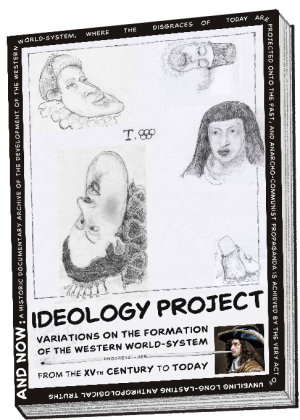
Propaganda by the Act of Remembering is an installation-archive commissioned for the exhibition Maquinaciones (MNCARS, 2023), and with it the Ideology Project begins — a political and institutional genealogy of the Western world-system. The work addresses political and anthropological aspects of contemporary culture in an exercise of archaeology of the present that seeks to disentangle the genealogies of the structures we inhabit today. Composed of diagrams, images, and historical documents, it traverses in six jumps selected moments of history, with its principal focus on the years around 1790, when France and Haiti underwent revolutions decisive to the configuration of the Western political order — thereby establishing, from this first chapter onwards, the colonial and anti-Eurocentric axis that will run through the project as a whole.
The rawness of the documents is combined with original analytical diagrams and graphic evocations in the construction of a counter-hegemonic historical account capable of suggesting new approaches to the events; an iconographic inversion that departs from the decorum of the hegemonic historical narrative and recovers the militancy of images, understood as receptacles of political action. The accumulation of events in diagrammatic form, as seen in large-format pieces such as Vases of Illumination, condenses historical narratives into a cosmography that builds its own ontology and explains the world from a standpoint that is at once analytical and ideological. This mode of representing —a thick description of the political, or political thick description— constitutes a wager that is not only historiographic but also epistemological: an essay on the effect of the forms and receptacles of collective memory on the way we situate ourselves and inhabit the world in relation to others.
The installation Propaganda by the Act of Remembering thus constitutes the first chapter of the Ideology Project, whose continuations have also been shown at LaBifurk (Grenoble, 2025), at the Centre d'Art Santa Mónica, Barcelona, 2025 (Cosmogony), and within the framework of Museu Habitat, Barcelona, 2025 (Mannerisms...).
Propaganda por el acto de recordar es una instalación-archivo producida por encargo para la exposición Maquinaciones (MNCARS, 2023), y con ella se inicia el Proyecto Ideología, una genealogía política e institucional del sistema-mundo occidental. La obra aborda aspectos políticos y antropológicos de la cultura contemporánea en un ejercicio de arqueología del presente que busca dirimir las genealogías de las estructuras que hoy habitamos. Compuesta a partir de diagramas, imágenes y documentos históricos, recorre en seis saltos momentos selectos de la historia, con foco principal en los años en torno a 1790, cuando Francia y Haití experimentan revoluciones determinantes para la configuración del orden político occidental — y se establece, ya desde este primer capítulo, el eje colonial y anti-eurocéntrico que recorrerá el proyecto entero.
La crudeza de los documentos se combina con diagramas analíticos originales y evocaciones gráficas en la construcción de un relato histórico contra-hegemónico capaz de sugerir nuevas aproximaciones a los sucesos; una inversión iconográfica que se aleja del decoro del relato histórico hegemónico y recupera la militancia de las imágenes, entendidas como receptáculos de acción política. La acumulación de sucesos en forma de diagrama que se aprecia en piezas de gran formato como Vasos de Iluminación condensa relatos históricos en una cosmografía que construye su propia ontología y explica el mundo desde un punto de vista tan analítico como ideológico. Este modo de representar —una descripción espesa de lo político, o political thick description— constituye una apuesta no solo historiográfica sino también epistemológica: un ensayo sobre el efecto de las formas y receptáculos de memoria colectiva en nuestra manera de situarnos y habitar el mundo en relación con las demás.
La instalación Propaganda por el acto de recordar constituye, pues, el primer capítulo del Proyecto Ideología, cuyas continuaciones se han podido ver también en LaBifurk (Grenoble 2025), en el Centre d'Art Santa Mónica Barcelona, 2025 (Cosmogonía), o en el marco de Museu Habitat Barcelona, 2025 (Manierismos...)
Chapters
Trompas tentáculo, Land Extractors (1) scrutinises the origins of the ideological fabric by addressing the European kingdoms in their relation to the worlds they aim to engulf. The words of Canassatego and Diego de Tlaxcala's account of the arrival of les españoles suggest to us that worlds are about to be extinguished in one of the greatest human catastrophes ever to have occurred.
In Trees and Tree-Cycles (2) we enter a panopticist analysis of power that is saluted by Bentham, who from a canvas above indicates that we are of his same lineage. Louis XIV, at the centre of his Imperial Kingdom, embodies the paradigm of surveillance. Espionage and propaganda describe the epistemological manoeuvres of the Encyclopédie.
In Rey Red – Redistribution of the Absolutisms (3) a new world breaks through within the interior of the Ancien Régime. The gravedigging voices that exalt private property as the new cornerstone of revolutionary legislations can be heard. Olympe de Gouges's declaration of the rights of woman appears more as an appendix to the celebrations of the liberal order than as a fundamental act of resistance to be celebrated.
Transmigrations (4) — the declarations of Sophie de Grouchy on empathy resonate in a society still to structure its affects, one in which the formula declared by Adam Smith will come to prevail: one ought to be affected by what happens to oneself, to one's family, and to one's nation.
In Ganarles el dinero – Wheels of Capital (5) the guilds have become obsolete. There is a new scheme that has been refined in the Americas: the plantation is a form that will adapt to the new times, modulated for the metropolis by the humanist voice of the philosophes. Here we see it in its almost definitive form in the liberating plantation model that Sonthonax proposes for Haiti in 1794. The Haitian Revolution erupts and reverberates from the Caribbean to the heart of the Kingdom.
In Corps Avec ses Òrgans (6) an incipiently politicised population struggles for control of the new institutions, in a climate of violence and mistrust. Popular emotions lack cultural habits through which to crystallise their aspirations, and every contribution by those who lend them one carries ulterior motives and the risk of betrayal. Expropriations are decreed, the great speculators become the target of manifestos and the revolutionary press, and in political clubs and assemblies the overly educated are rightly suspected. The philosophes have written the recipe for the new order, but it is les politiques who will selectively adjust the organs of the new society, constituting themselves as a new, less personalised elite very difficult to dismantle. We can see Millet defending, on behalf of the members of the Club Massiac, the slaveholding society of Saint-Domingue before the National Convention. The King and his aristocracy are about to be murdered by a social class that seems at last to accept the advice the Tupinambá gave to their compatriot Montaigne centuries earlier: if your Kings treat you thus, why do you not kill them? (implicit in the voice we gather in one of the drawings: if you treat your halves thus, why do they not kill you?)
Capítulos
Trompas tentáculo, Land Extractors (1) escrutina los orígenes del entramado ideológico abordando los reinos europeos en su relación con los mundos que pretenden engullir. Las palabras de Canassatego y el relato de Diego de Tlaxcala de la llegada de les españoles nos sugieren que los mundos van a ser extinguidos en una de las mayores catástrofes humanas que hayan sucedido jamás.
En Trees and Tree-Cycles (2) entramos en un análisis panopticista del poder que es saludado por Bentham, que desde un lienzo por arriba nos indica que somos de su misma estirpe. Luis XIV, en el centro de su Reino Imperial, encarna el paradigma de la vigilancia. El espionaje y la propaganda describen las maniobras epistemológicas de la Enciclopedia.
En Rey Red – Redistribución de los Absolutismos (3) un mundo nuevo se abre paso en el interior del Antiguo Régimen. Se escuchan las voces enterradoras que ensalzan la propiedad privada como la nueva piedra angular de las legislaciones revolucionarias. La declaración de derechos de la mujer de Olympe de Gouges parece más una apostilla a las celebraciones del orden liberal, que un acto de resistencia fundamental que debemos celebrar.
Transmigraciones (4) — las declaraciones de Sophie de Grouchy en torno a la empatía resuenan en una sociedad que todavía ha de estructurar los afectos, y en la que se impondrá la fórmula que declara Adam Smith: uno debe afectarse por lo que le sucede a sí mismo, a su familia y a su nación.
En Ganarles el dinero – Wheels of Capital (5) los gremios se han vuelto obsoletos. Hay un nuevo esquema que se ha refinado en América: la plantación es una forma que se adaptará a los nuevos tiempos, modulada hacia la metrópolis por la voz humanista de los philosophes. Aquí vemos su forma casi definitiva en el modelo liberador de plantación que propone Sonthonax para Haití en 1794. Estalla la revolución haitiana, que reverbera desde el Caribe hasta el corazón del Reino.
En Corps Avec ses Òrgans (6) una población incipientemente politizada pugna por el control de las nuevas instituciones, en un clima de violencia y desconfianza. Las emociones populares carecen de hábitos culturales para cristalizar sus aspiraciones y cada aportación de quien se las presta tiene segundos motivos y representa un riesgo de traición. Se decretan expropiaciones, las grandes especuladoras se convierten en objetivo de manifiestos y de la prensa revolucionaria, y en los clubes políticos y en las asambleas se sospecha acertadamente de la gente demasiado instruida. Los philosophes han escrito la receta del nuevo orden, pero son les politiques quienes ajustarán selectivamente los órganos de la nueva sociedad, constituyéndose en una nueva élite menos personalizada muy difícil de desarticular. Podemos ver cómo Millet defiende, en representación de los miembros del Club Massiac, la sociedad esclavista de Saint-Domingue frente a la Convención Nacional. El Rey y su aristocracia están a punto de morir asesinados por una clase social que parece finalmente aceptar la sugerencia que los tupinambás le hicieron a su compatriota Montaigne siglos atrás: ¿si vuestros Reyes os tratan así, por qué no los matáis? (implícita en la voz que recogemos en uno de los dibujos: ¿si tratáis así a vuestras mitades, porqué no os matan?)
. Trompas Tentáculo · Land Extractors


. Trees and Tree Cycles


. Redistribution of Absolutism


. Transmigrations


. Weels of Capital


Vases of Illumination
300 × 150 · Electronic image
This grand cosmographic schema maps the economic, political, and cultural relations that link Parisian and Haitian societies on both sides of the Atlantic in the early 1790s. It sets out multiple aspects of the cultural process known as the Enlightenment, which culminated in the introduction of a very significant part of today's institutions and of modern culture.
In a Veblenian dichotomy, the lower quadrants separate the world of labor — where the forces of production and the bodies that compose them have become an impersonal mass that feeds and sustains the system — from the world of leisure, the sphere where the political and vital disputes of desiring bodies take place once stripped of the necessities of their own survival.
The institutions of the revolution force their way through a world rabid for change, in which social classes throw themselves into reordering their relations and generational ambitions crystallize in a process of creative destruction and a new ideological configuration.
The drawing employs the concept of the Leisure Class introduced by Thorstein Veblen as a classification of social groups (The Theory of the Leisure Class, 1899), but transforms it into a division of time: it asks how the different social classes take part in the performance of culture and, therefore, how they integrate into the collective apparatus that allows us to think and to locate ourselves in the world.
The iconographies conjured in the drawing struggle to contain aspects and synchronicities of political life that habitually remain latent and concealed in discourse and in the written text.
Vasos de Iluminación
300 × 150 · Imagen electrónica
Este gran esquema cosmográfico cartografía las relaciones económicas, políticas y culturales que enlazan las sociedades parisinas y haitianas a ambos lados del Atlántico a principios de la década de 1790. Se representan múltiples aspectos del proceso cultural conocido como Ilustración, que culminó en la introducción de una parte muy importante de las instituciones actuales y la cultura moderna.
En una dicotomía vebleniana, los cuadrantes inferiores separan el mundo del trabajo, donde las fuerzas de producción y los cuerpos que las componen se han convertido en una masa impersonal que alimenta y sostiene el sistema, del mundo del ocio, la esfera donde tienen lugar las disputas políticas y vitales de los cuerpos deseantes una vez despojados de las necesidades de su propia supervivencia.
Las instituciones de la revolución se abren paso en un mundo rabioso por cambiar, en el que las clases sociales se lanzan a reordenar sus relaciones y las ambiciones generacionales cristalizan en un proceso de destrucción creadora y una nueva configuración ideológica.
El dibujo se sirve del concepto de la Clase Ociosa introducido por Thorstein Veblen como clasificación de grupos sociales (The Theory of the Leisure Class, 1899) pero lo transforma en una división del tiempo: se pregunta cómo las distintas clases sociales participan en el desempeño de la cultura y, por tanto, cómo se integran en el aparato colectivo que nos permite pensar y situarnos en el mundo.
Las iconografías que se conjuran en el dibujo luchan por contener aspectos y sincronicidades de la vida política que habitualmente permanecen latentes y disimuladas en el discurso y el texto escrito.


. Corps Avec ses Organs


.jpg "6 CAO-2 itemized mobilization 2022 (Medium)")


.jpg "6 CAO-6b2 Carteau - aristocracy of the skin antiracism 1802 (Medium)")

.jpg "6 CAO-7a Commune-Affranchie EXPROPIATE 1793 (Medium)")
.jpg "6 CAO-7n (Medium)")


(<atras-back)